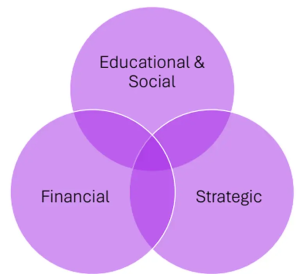
Table of Contents
A Re-Introduction Fierce Outcomes
Fierce committed to improved results for universities and independent schools blending advanced analytics, strategy, and end-to-end operational / PMO support

- McKinsey and BCG: Decade as Partner in Education Practice and leading Advanced Analytics
- Measuring Success: Founder and CEO, data driven decision making for independent schools
- Served: More than 1,000 independent schools and universities
- Education: Horace Mann School(NYC), Yale (Applied Math), Harvard (MPA), Kellogg (MBA)
Trends in higher education are decidedly mixed…
Yet some have successfully “bent the curve” to return to health. What can independent schools learn from them?
- Weakened value proposition: Public trust losses from politicization of campus, weak grad rates, under- employed
- Career- focused non-degree alternatives: Certificates, badges, certification without degrees
- Downward demographic shifts: For first-time full-time for next several years
- Non-elites Over- discounting: 56% avg discount rate; race to bottom, buy students
- Dirty secret: After top 50, colleges are not selective
- Elites want diverse spikes: Matrix of students as broad as humanly possible, also makes them look more selective
- Business model mess: Too many programs, tenure, inability to focus on right to win
(School) Price is Right Wheel

Our approach today
- Understanding concept
- Use case or analytical model from higher education
- Independent school applications – encourage discussion
Several articles I will be referring to throughout if you want more details on these ideas
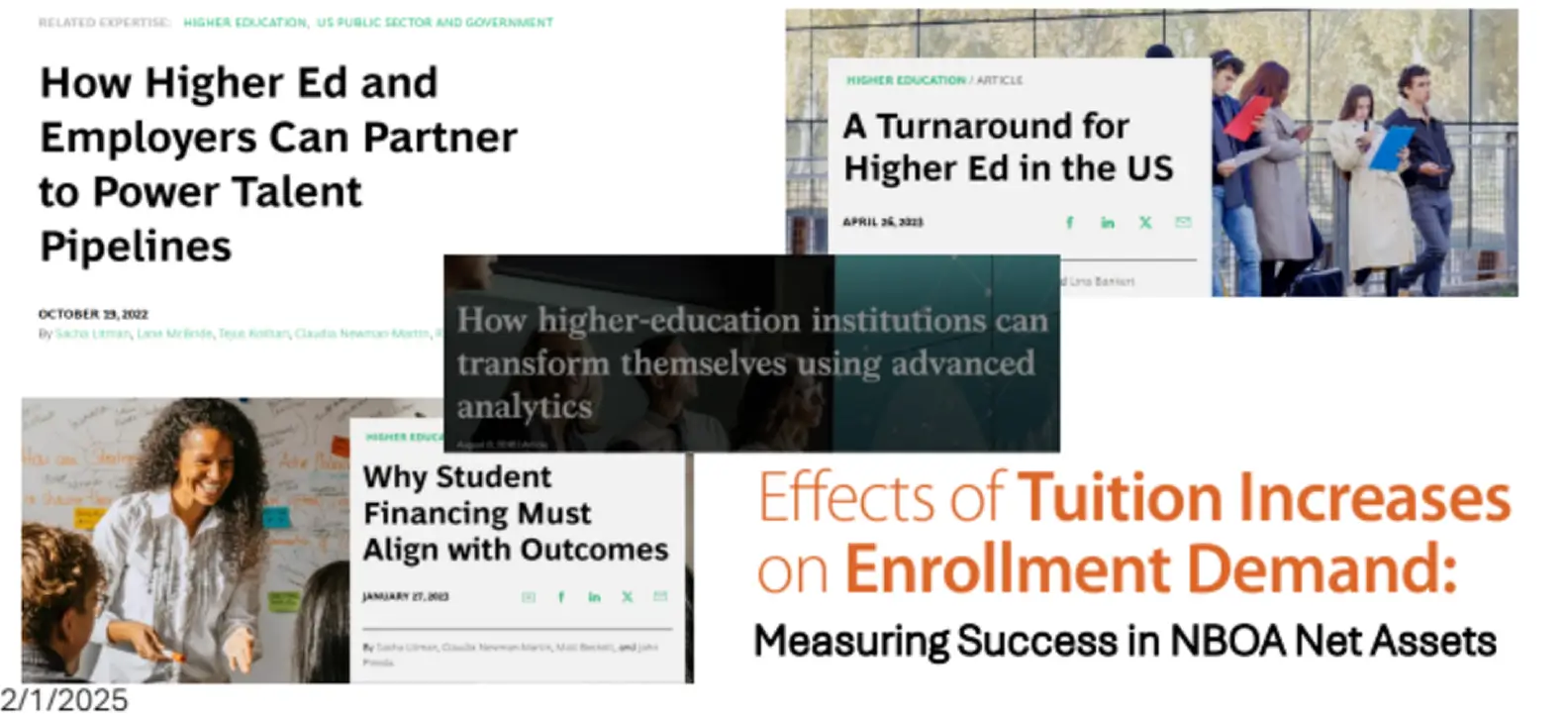
Graduate outcomes | Confidence in career & life outcomes
Concept:
- Ladder of ROI outcomes:
1. Graduate, 2. First job, 3. In demand job, 4. Promoted, 5. Career, 6. Earnings above alternative, 7. Life satisfaction (values, family, character, friends network, etc)
Case Study / Analytical Example:
- University Sharing Risk:
1.Take courses free after graduate until find job in your field, 2. Free reskilling until 30, 3. Employer partnerships offering internships, research, curriculum influence, jobs, 4. Employer repays your student loans
Indep. School Implications:
- What demonstrates ROI?:
1.Preparedness for college (by far #1 factor on NPS), 2. Privileged college access via recruiters / awareness, 3. Admission to reach colleges, 4. HS internship experience differentiator for college, 5. Is life satisfaction? char values, network #2 NPS
Guarantees? Dual enroll in advanced courses, internship?
Higher Education ROI today quality first, career rising in importance
Pre- to post-COVID shift in brand strength of higher ed (Encoura)
- Career-minded only brand attribute to grow, across all school types
- Quality #1 still (catch all for value proposition)
Top 2 drivers of perceived value of college degree from alumni (Gallup)
- Career preparedness
- Faculty mentor in career area
ROI (IPEDS DOE)
- 60% of students in bachelor’s complete their degree
- 52% of those with bachelors “underemployed”
- 4.6m college students want internship, cannot get one
- 22% colleges have effective employer partnerships, 87% say it is priority
…mimics what we see in independent schools preparedness theme
Top drivers of perceived value (likelihood to recommend, NPS) from Measuring Success
- Preparedness for next academic environment (HS, college) 2x magnitude of 2nd factor
- Customer service (proactive and reactive communications)
- Character development
Value proposition what is your brand’s distinction that leads to the outcomes / ROI?
Concept:
- What’s Your North Star?:
1. Achieve distinctiveness in market…Right to Win, 2. Build reputational strengths into pillars, invest in those programs of study, 3. Achieve “table stakes” in other areas…other programs can buttress the pillars, 4. Ensure big enough target market to whom your value prop will appeal.
Case Study / Analytical Example:
- 1.Vanderbilt anti-ivy collaboration, interdisc, dialogue, 2. Pitt Health Sciences, 3. Catholic universities: is
Catholic formation sufficient?, 4. U Tulsa scholars to avoid false dichotomies – “T” shape
Indep. School Implications:
- 1.Legacy brand If you are one of 2-3 local “ivies”, 2. Immersion schools (language, STEM, IB schools), 3. Social propinquity as brand: Dwight School rebrands from rich, rough kids into global leaders’ curriculum and network, 4. Faith schools’ challenge: faith formation expected competence, but can throw doubt on strength of general academics
Brand value in education luxury corporate brand repositioning insights
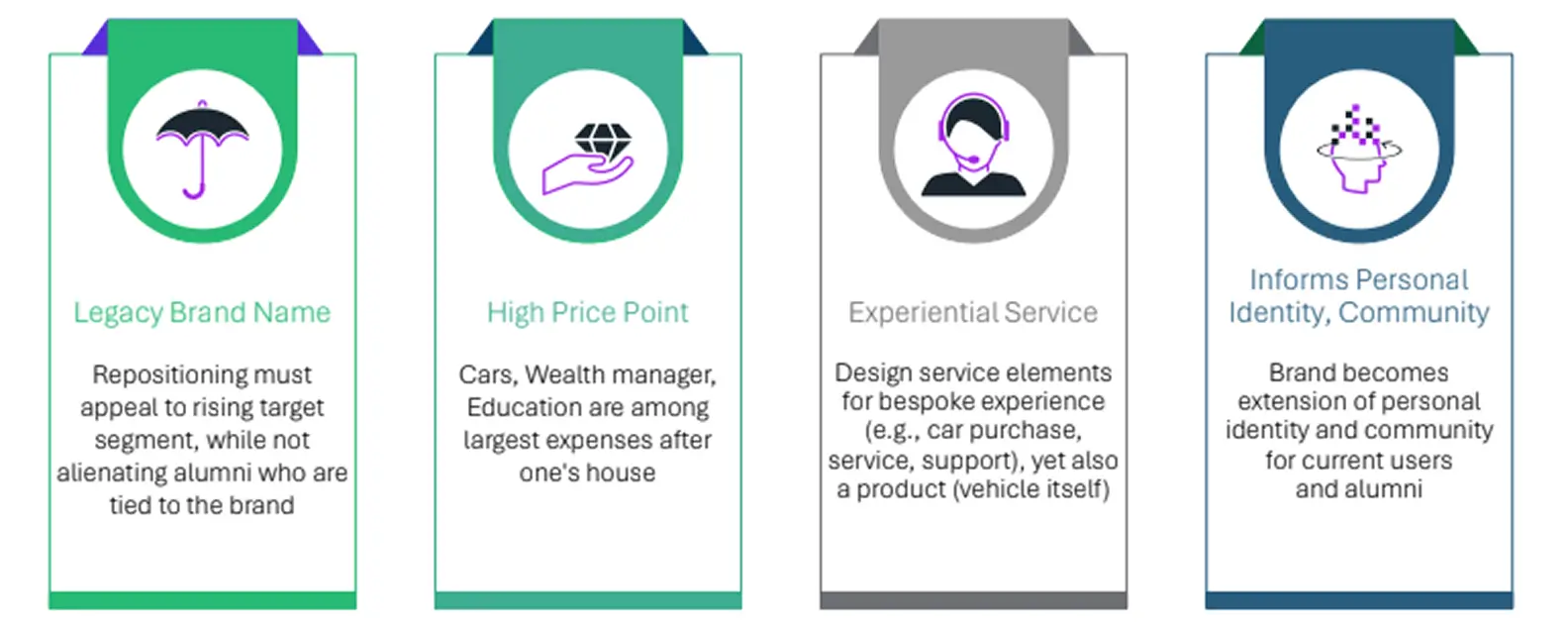
Higher Willingness to Pay and Enrollment Selectivity, ROI reduces discount rate and boosts enrollment
Concept:
- 1. Scarcity principle – people willing to pay for what they cannot have. • Drive up applications • Cap frosh enrollment • Use early action / early decision to spike yield, 2. Marketing swagger by promoting strong outcomes and clear value proposition, 3. Leverage top admin, faculty in admissions.
Case Study / Analytical Example:
- 1.Psychology of over- discounting / “buying students” • Prospective families play let’s make a deal
• Administration: commodity mindset • Alumni: reduce confidence donations going to those in need,
2. Top ranked university model of diversity drove acceptance rate and now WTP.
Indep. School Implications:
- 1.Selectivity builds long term price realization and growth: • Cap number of classrooms at
conservative figure for entry grades K, 9th and build waitlist; only open new classrooms once can fill
them, 2. If at capacity, determine your desired student body composition, 3. Be need aware in admissions, as are all universities even elites.
Net tuition revenue (NTR) highly correlated with both acceptance rate and post-graduation earnings

Tuition increase impact on enrollment funnel analysis of 259 independent schools reinforces it’s about value!
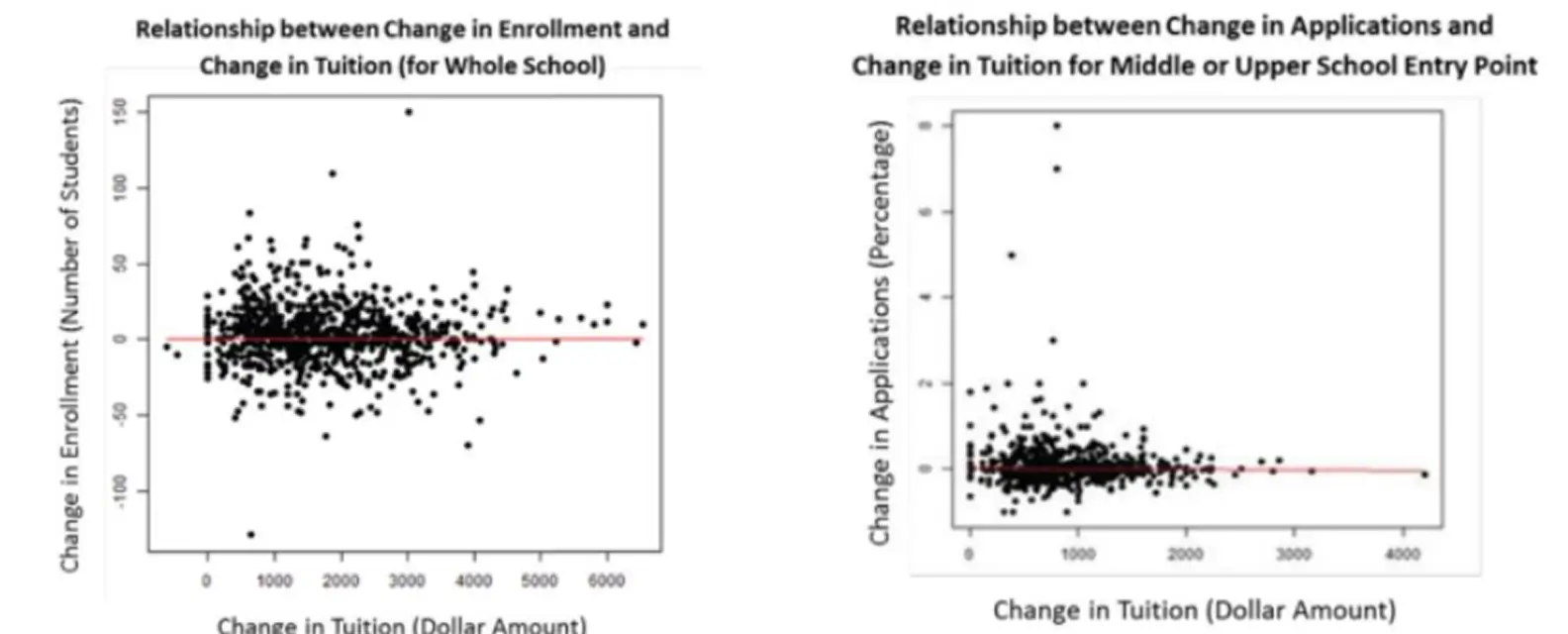
Lack of financial aid “spread” many non-selectives discount strategy awards all students aid across tiers and income groups

Financial Sustainability watch the coverage ratio!
Concept:
- 1. Cannot cut your way to success, 2. Need invest in value creation to bridge funding to pivot out of a vicious cycle, 3. Avoid “peanut butter spread” Invest in targeted manner to strengthen value prop and outcomes
Case Study / Analytical Example:
- 1.Non-performing programs
Indep. School Implications:
- 1.A few viable models: • Selective, “top families” • Large, tracks • Mission alignment (often faith based),
2. Beware unintentional internal subsidies:, price to cost per student and manage financial aid so coverage ratio ~80% • ECC,
Pivoting from Vicious to Virtuous Cycle

Turnarounds University of Tulsa evidence suggests it can be done
Enrollment up:
- 33% increase in FTFT (frosh) enrollment
- Bold vision to get to 1,000 frosh
- Aim for R1, top 75
Financial Aid down
- 16% increase in net tuition revenue ($2,000 per student)
Greater mission alignment
- 12 percentage point increase in Pell eligible
- 6 percentage point increase in racial diversity of students
Viable Typologies don’t get caught in the middle!
Top Private School Model
- Only accept “best families” (by wealth, academic ability)
- Scarcity principle, though in practice less selective than project publicly if “right family”
- Fin. Aid: top price, 80- 90% net tuition revenue
Top Public School Model
- Everyone admitted
- Large size benefits
- Tracking by subject – advanced and lower levels for all subjects, from ES through HS
- Meets individual child strengths/weaknesses
- Fin. Aid: free, though selective by cost of real estate
Two track mission model
- Trend in state schools and faith-based
- Admit those who meet mission criteria
- Honors program for those families with highest academic expectations
- Limited financial aid for honors, high for regular
To “bend the curve,” service providers need to engage differently as well
- Take responsibility for school outcomes
- Create a model using longer term engagements to achieve outcomes
- In God we trust, all others bring good data! Data is the voice of customer.
- Joint accountability via Board of Trustees and HOS engagement, from judgment to continuous quality
improvement
Wheel of (School) Fortune
Lenses for decision making in a school
- To what extent is decision making happening along these lines currently?